The
Library History Buff
Promoting the appreciation, enjoyment, and preservation of library history
The Library Company of Philadelphia
Benjamin
Franklin and a group of friends founded the
Library Company of Philadelphia
in 1731 when Franklin was 25 years old. It was America's
first lending library and can lay claim to being the predecessor of the free
public library. For a brief period (Dec. 1733-Mar. 1734) Franklin actually
served as the librarian for the Library Company. He also served as its
secretary from 1746 to 1757.
"And now I set on foot my first project of
a public nature, that for a subscription library ... this was the mother of all
the North American subscription libraries, now so numerous. It is become a
great thing itself, and continually increasing. These libraries have
improved the general conversation of the Americans, made the common tradesmen
and farmers as intelligent as most gentlemen from other countries, and perhaps
have contributed in some degree to the stand so generally made throughout the
colonies in defense of their privileges." - The Autobiography of
Benjamin Franklin
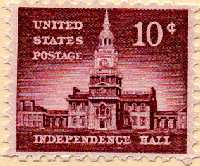 Initially
the library was located in the private residence of one of its members.
The Library moved to the Pennsylvania State House (now known as Independence
Hall) in 1740. It stayed in this location for 34 years. Independence Hall
is depicted on several United States postage stamps and on some stamps of other
countries.
Initially
the library was located in the private residence of one of its members.
The Library moved to the Pennsylvania State House (now known as Independence
Hall) in 1740. It stayed in this location for 34 years. Independence Hall
is depicted on several United States postage stamps and on some stamps of other
countries.
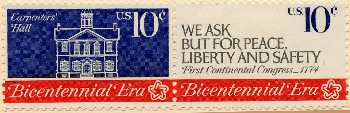 In
1773 the Library rented two rooms in a new building called Carpenter’s Hall.
When the Continental Congress convened in Carpenter’s Hall in 1774, Members of
the Congress were given access to the Library. The same courtesy was extended
to future Congresses. Between 1774 until the Library of Congress was
established in 1800, the Library Company could be considered the de facto
Library of Congress.
In
1773 the Library rented two rooms in a new building called Carpenter’s Hall.
When the Continental Congress convened in Carpenter’s Hall in 1774, Members of
the Congress were given access to the Library. The same courtesy was extended
to future Congresses. Between 1774 until the Library of Congress was
established in 1800, the Library Company could be considered the de facto
Library of Congress.
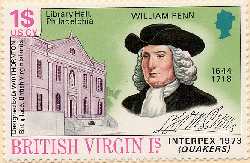 In
1790, the Library moved into its own building on Fifth St. where its stayed
until 1880. Library Hall is depicted along with William Penn on this 1979
postage stamp of the British Virgin Islands. It is one of the few free
standing American library buildings depicted on a postage stamp.
In
1790, the Library moved into its own building on Fifth St. where its stayed
until 1880. Library Hall is depicted along with William Penn on this 1979
postage stamp of the British Virgin Islands. It is one of the few free
standing American library buildings depicted on a postage stamp.
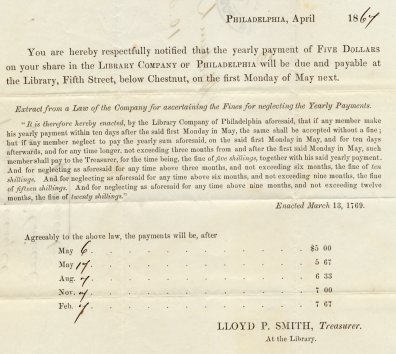 An
annual statement of dues sent to a Library Company member by Treasurer and
Librarian Lloyd P. Smith in April, 1864.
An
annual statement of dues sent to a Library Company member by Treasurer and
Librarian Lloyd P. Smith in April, 1864.
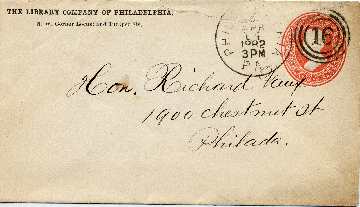 On
February 24, 1880, the Library moved into a new building at the Northwest corner
of Locust and Juniper Streets. The envelope at the left was mailed just a little
more than two years after that move.
On
February 24, 1880, the Library moved into a new building at the Northwest corner
of Locust and Juniper Streets. The envelope at the left was mailed just a little
more than two years after that move.
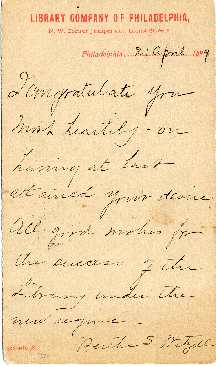 On
this postal card mailed on April 21, 1889, Bertha S. Witzell, probably a Library
Company staff member, writes a congratulatory note to Albert Durham, the new
director of the Reading Public Library in Reading, PA. on his appointment.
On
this postal card mailed on April 21, 1889, Bertha S. Witzell, probably a Library
Company staff member, writes a congratulatory note to Albert Durham, the new
director of the Reading Public Library in Reading, PA. on his appointment.
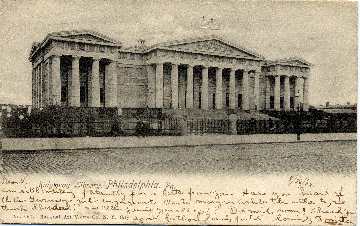 The
Ridgeway Library building was given to the Library Company in 1878 as the result
of an earlier bequest of almost a million dollars from Dr. James Rush. The
building was reluctantly accepted by the Library Company and was never used as
the primary service point of the Library. This picture postcard of the
Ridgeway Library was mailed to England in 1904.
The
Ridgeway Library building was given to the Library Company in 1878 as the result
of an earlier bequest of almost a million dollars from Dr. James Rush. The
building was reluctantly accepted by the Library Company and was never used as
the primary service point of the Library. This picture postcard of the
Ridgeway Library was mailed to England in 1904.
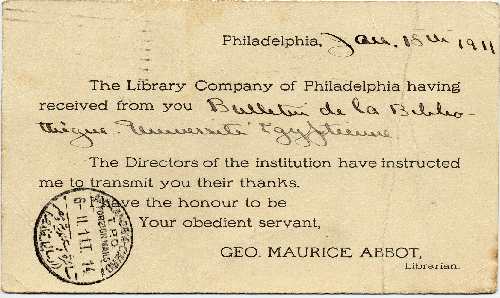 George
Maurice Abbot served as Librarian of the Library Company from November 7, 1907
to June 30, 1929. This postal card from Abbot was mailed on January 20,
1911 to the Librarian of the Egyptian University in Cairo to acknowledge a gift.
George
Maurice Abbot served as Librarian of the Library Company from November 7, 1907
to June 30, 1929. This postal card from Abbot was mailed on January 20,
1911 to the Librarian of the Egyptian University in Cairo to acknowledge a gift.
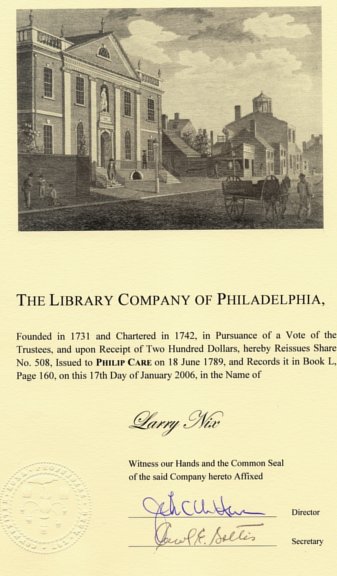 To
help celebrate the 275th anniversary of the Library Company of Philadelphia I
became a share holder of the Library Company. On January 17, 2006 I was
reissued Share No. 508 which was issued to Philip Care on June 18, 1789. Philip
Care was the 2nd husband of Sarah Bartram Bertier. They both lost their spouses
in the yellow fever plague of 1793 in Philadelphia. Sarah was the daughter of
Isaac Bartram. He was a druggist and a member of the American Philosophical
Society. His father was John Bartram, formerly the king's botanist in America
and considered the father of American botany. John Bartram was a close friend of
Benjamin Franklin and co-founder of the American Philosophical Society. This
provides an interesting connection between my share and the founder of Library
Company of Philadelphia. I'm grateful to Ken Piper, a descendent of Sarah
Bartram and Claude Antoine-Bertier, for this background informatin on Philip
Care.
To
help celebrate the 275th anniversary of the Library Company of Philadelphia I
became a share holder of the Library Company. On January 17, 2006 I was
reissued Share No. 508 which was issued to Philip Care on June 18, 1789. Philip
Care was the 2nd husband of Sarah Bartram Bertier. They both lost their spouses
in the yellow fever plague of 1793 in Philadelphia. Sarah was the daughter of
Isaac Bartram. He was a druggist and a member of the American Philosophical
Society. His father was John Bartram, formerly the king's botanist in America
and considered the father of American botany. John Bartram was a close friend of
Benjamin Franklin and co-founder of the American Philosophical Society. This
provides an interesting connection between my share and the founder of Library
Company of Philadelphia. I'm grateful to Ken Piper, a descendent of Sarah
Bartram and Claude Antoine-Bertier, for this background informatin on Philip
Care.
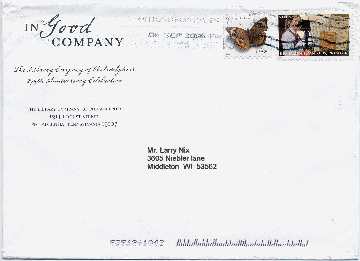 One of the perks of this status is receiving regular mailings from the Library.
This envelope contained an invitation to "In Good Company" a reception, dinner,
and program on November 8, 2006 to celebrate the 275th anniversary of the
Library Company.
One of the perks of this status is receiving regular mailings from the Library.
This envelope contained an invitation to "In Good Company" a reception, dinner,
and program on November 8, 2006 to celebrate the 275th anniversary of the
Library Company.
More on the history of the Library Company of Philadelphia
can be found at
http://www.librarycompany.org/about/history.htm
.
This site created and maintained
by
Larry T. Nix
Send comments or questions to
nix@libraryhistorybuff.org
Last updated: 02-06-12
© 2005-2012 Larry T. Nix
Also check out the
Library History Buff Blog.